
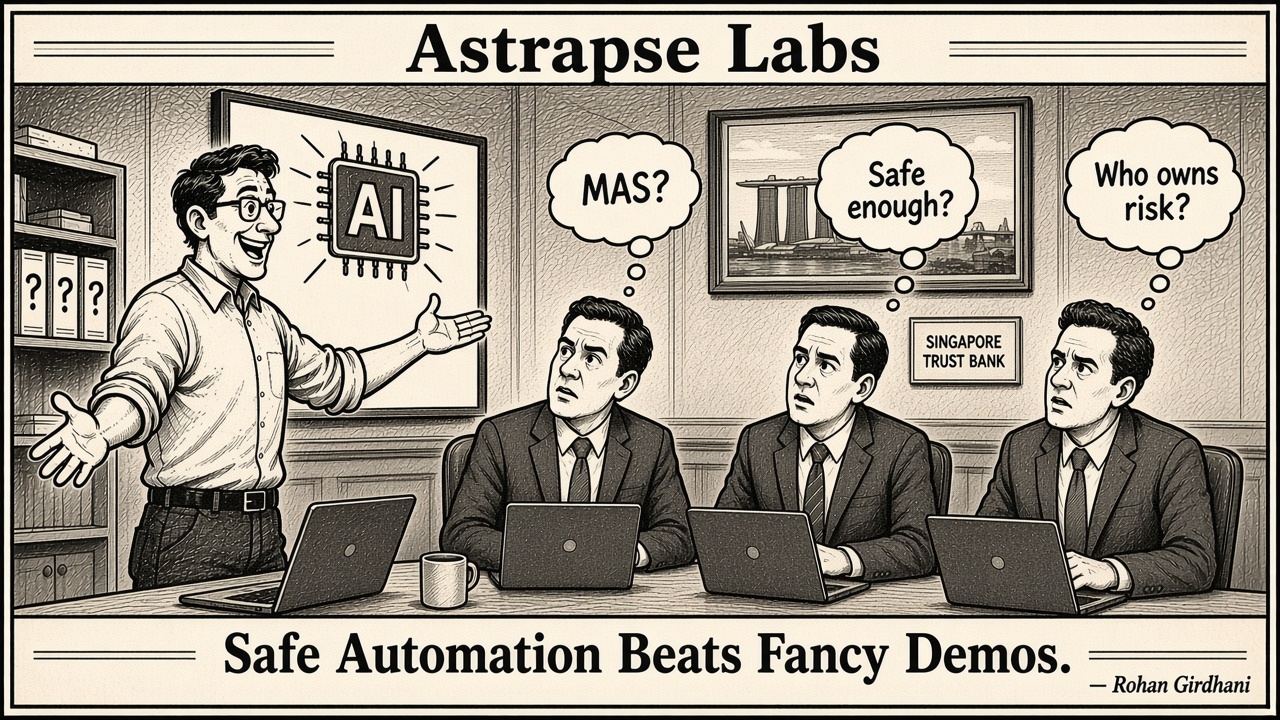
The conversation is heating up after the recent announcement that the financial services sector could receive up to S$100 million in MAS grants to boost quantum and AI capabilities Source. In Singapore, the Monetary Authority of Singapore (MAS) is shaping a governance model that blends innovation with strict risk controls. For CEOs and CTOs, the key question is: where is it safe to automate?
Sector brief
Fintech firms operate at the intersection of rapid product cycles and heavy regulatory oversight. Core activities—payments, lending, wealth management, and insurance—must meet anti‑money‑laundering (AML), know‑your‑customer (KYC), data‑privacy, and capital‑adequacy rules. At the same time, market pressure pushes for faster onboarding, personalized offers, and 24/7 service.
Our experience across 30+ shipped startups in the US, Europe, the Middle East, India, and Singapore shows that the most successful AI projects are those that are designed with compliance in mind from day one. When the same team that advises also builds and runs the solution, the hand‑off risk disappears, and governance can be baked into the architecture.
Where AI pays back in fintech and financial services
| Function | AI impact | Governance considerations |
|---|---|---|
| Regulatory reporting | Automated data extraction and classification reduce manual filing time and error rates. | Models must be auditable; MAS expects clear lineage of data sources and transformation logic. |
| Fraud detection | Real‑time anomaly detection using machine‑learning ensembles catches illicit transactions faster than rule‑based systems. | Continuous model monitoring is required; false‑positive rates must be reported to regulators. |
| Customer onboarding | AI‑driven document verification and risk scoring accelerate KYC while maintaining accuracy. | Data residency and encryption must align with ISO/IEC 27001 standards; MAS‑approved third‑party services are preferred. |
| Personalized product recommendation | Recommendation engines increase cross‑sell conversion without additional human effort. | Explainability is essential; the model must be able to surface why a recommendation was made for compliance reviews. |
| Operational risk monitoring | Natural‑language processing (NLP) scans internal communications for policy breaches. | Retention policies and privacy safeguards must be documented to satisfy regulator audits. |
In each of these areas, the return on investment comes from reduced labor, lower error‑related penalties, and faster time‑to‑market. However, the payoff is contingent on a governance framework that satisfies MAS expectations for model risk management, data protection, and auditability.
Where AI does not pay back—or requires extra caution
- High‑frequency trading (HFT) algorithms – The speed and opacity of deep‑reinforcement models can clash with MAS’s requirement for explainable decision‑making. The cost of building a compliant audit trail often outweighs the marginal speed gains.
- Legacy core banking replacement – Swapping a monolithic core system for an AI‑driven one introduces massive integration risk. Without a proven migration path and regulatory sign‑off, the effort can stall projects for years.
- Unstructured data mining without consent – Using social‑media or third‑party datasets for credit scoring may breach Singapore’s Personal Data Protection Act (PDPA) and MAS guidelines on data ethics.
- Fully autonomous underwriting – While AI can assist, a fully hands‑off underwriting engine can expose the firm to model‑drift risk and regulatory penalties if decisions cannot be justified.
In these zones, the cost of compliance—including model validation, documentation, and ongoing monitoring—can exceed the efficiency gains. CEOs should treat them as pilot‑only or defer until the regulatory framework matures further.
Three questions every fintech CEO should ask
- How does the AI model align with MAS’s model‑risk‑management (MRM) expectations? Do we have clear documentation of data provenance, model design, and validation procedures?
- What is the data‑privacy impact of the solution? Are we storing personal data in jurisdictions approved by MAS and adhering to ISO/IEC 27001 controls?
- What is the exit or rollback plan if the model fails regulatory review? Do we have versioned models, test suites, and a governance board ready to intervene?
Answering these questions early narrows the scope of the feasibility study and ensures that the subsequent recommendation is costed and falsifiable, a principle we champion in our advisory work.
One concrete first move
Launch a compliance‑focused AI pilot for AML transaction monitoring.
- Define scope – Target a single product line (e.g., peer‑to‑peer payments) and a representative data set from the past 12 months.
- Select a vendor or build in‑house – Use a vendor that provides model‑explainability dashboards and supports MAS‑approved model‑validation APIs.
- Costed recommendation – Our Advisory mode will produce a detailed cost‑benefit model, including infrastructure, staffing, and audit costs, before any code is written.
- Guided execution – If the board approves, we move to Guided mode, staying alongside your team for data‑pipeline setup, model training, and regulator‑ready documentation.
- Measure and decide – After a 6‑week pilot, compare detection rates, false‑positive reduction, and audit readiness against the baseline. The results determine whether to scale or pivot.
This approach satisfies three criteria: it delivers tangible risk‑reduction value, it aligns with MAS’s emphasis on model governance, and it provides a clear, measurable outcome that can be presented to the board.
Closing note
Automation under MAS‑style governance is not a binary choice; it is a disciplined process of aligning technology with risk controls. By starting with a narrowly scoped, compliance‑driven pilot, you can validate the hypothesis, satisfy regulators, and build a foundation for broader AI adoption.
We look forward to discussing how this approach fits your organization.
FAQ (mirrored)
- How does MAS evaluate AI model risk? MAS expects a documented model‑risk‑management framework covering model design, validation, monitoring, and governance.
- Can we use open‑source AI tools and still meet MAS standards? Yes, if they are integrated into a controlled pipeline with proper audit logs and ISO/IEC 27001 controls.
- What is the typical timeline for an AI pilot in a regulated fintech? Around 6‑8 weeks from scoping to results.
- How do we budget for AI projects under MAS governance? Begin with a costed recommendation that details data, model, validation, and monitoring expenses.
- When should we consider moving from advisory to delivery? When the pilot shows compliance, ROI, and a need for execution expertise.
Sources
Frequently asked
How does MAS evaluate AI model risk?
MAS expects a documented model‑risk‑management framework covering model design, validation, monitoring, and governance, with audit‑ready explainability.
Can we use open‑source AI tools and still meet MAS standards?
Yes, if the tools are integrated into a controlled pipeline that records data provenance, enforces access controls, and complies with ISO/IEC 27001 security requirements.
What is the typical timeline for an AI pilot in a regulated fintech?
A focused pilot usually takes 6 to 8 weeks, covering data preparation, model development, validation, and a compliance review.
How do we budget for AI projects under MAS governance?
Start with a costed recommendation that itemizes data engineering, model development, validation, documentation, and ongoing monitoring costs.
When should we consider moving from advisory to delivery?
If the pilot demonstrates regulatory compliance, clear ROI, and internal capability gaps, the Advisory + Delivery mode lets us build, run, and hand over the solution.
Markdown: /blog/ai-in-fintech-and-financial-services-under-mas-governance.md