
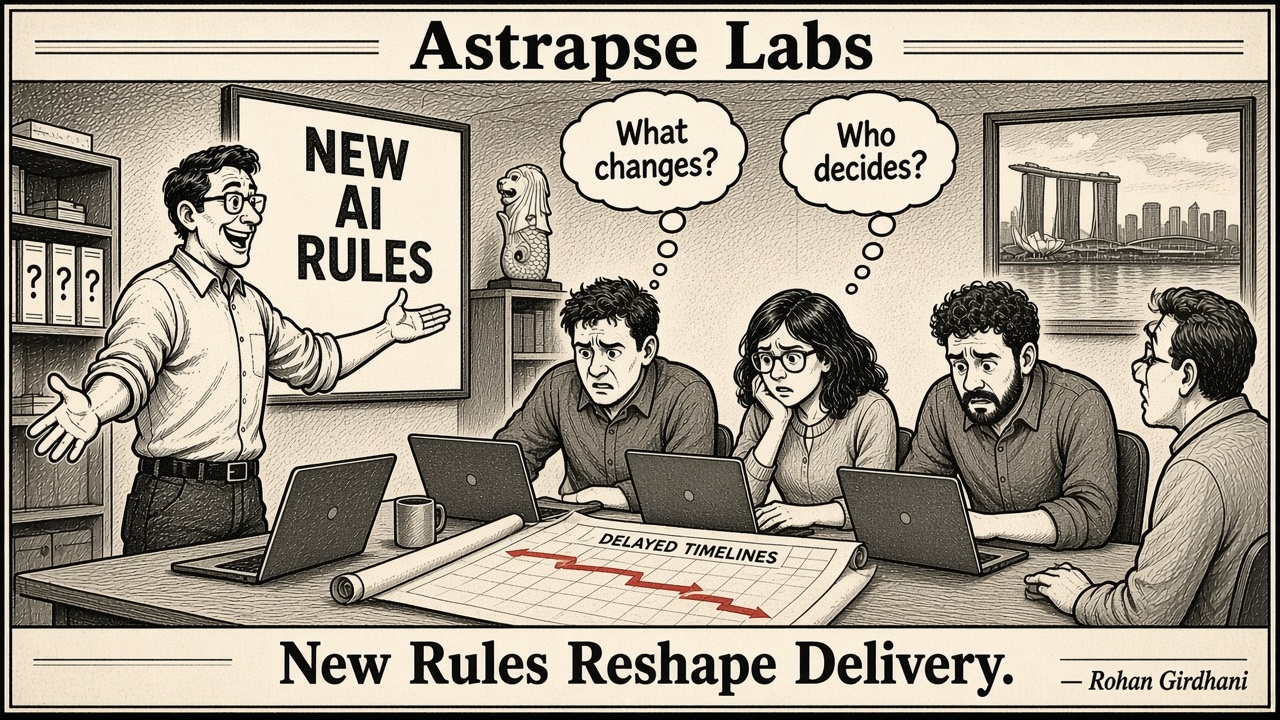
The headline Singapore: New AI Initiatives Accelerate Enterprise Transformation published on 27 Oct 2026 outlines Singapore’s push to embed AI across critical sectors, backed by a new governance framework and funding incentives.
What it signals
- Regulatory intent is moving from guidance to enforceable standards. The Ministry of Trade and Industry (MTI) is rolling out an AI Governance Framework that references ISO/IEC 27001 controls and introduces sector‑specific risk matrices.
- Enterprise budgets will now include compliance headroom. Funding programs are tied to demonstrable adherence to the framework, meaning AI projects must be built with auditability from day one.
- Speed of adoption will be measured against governance milestones. The roadmap sets quarterly checkpoints for data provenance, model explainability, and impact assessments.
What it does not prove
- It isn’t a blanket certification. The framework leaves room for interpretation; compliance will still depend on how each organization maps its processes to the controls.
- No guarantee of uniform enforcement across all industries. Early pilots focus on finance and health; other sectors may see a phased rollout.
- It won’t eliminate technical risk. Model drift, data quality, and talent gaps remain core challenges that regulation does not solve.
The one decision it should change
Shift from project‑centric AI experimentation to a delivery‑centric, governed model. In practice, that means the team that recommends an AI solution also owns its implementation, embedding compliance checkpoints into the development pipeline. Our three engagement modes—Advisory, Guided, and Advisory + Delivery—are built around this principle. When the same team designs, builds, and runs the system, they can ensure the ISO‑based controls are baked in, rather than retro‑fitted after a proof‑of‑concept.
What to do Monday
- Audit your current AI inventory. List every model, data source, and downstream consumer. Note any existing compliance artefacts (e.g., data lineage, model cards).
- Map gaps to the Singapore framework. Use the risk matrix published by MTI as a checklist; flag any missing documentation or control.
- Schedule a 30‑minute discovery call with us. We’ll walk through the audit, identify quick wins, and outline a delivery plan that aligns with the new standards. Book here: https://calendly.com/rohan-girdhani/discovery-call.
- Assign a governance owner. This person will be responsible for quarterly checkpoints and will work directly with the delivery team.
By treating regulation as a delivery requirement rather than an after‑thought, you reduce rework, protect budget, and keep your AI initiatives on schedule.
Internal Links
Sources
Frequently asked
How does ISO/IEC 27001 relate to the Singapore AI framework?
ISO/IEC 27001 provides the baseline information‑security controls that Singapore’s AI Governance Framework references. Aligning with ISO 27001 simplifies compliance and demonstrates a mature security posture.
Should we wait for the full framework before acting?
No. Early adopters can use the published sector‑specific risk matrices as a provisional checklist. Starting now prevents a large retro‑fit later.
Which engagement mode works best for regulated delivery?
Advisory + Delivery is the most seamless: the same team that advises on risk and design also builds the solution, ensuring compliance is embedded throughout.
How much does compliance add to total AI cost?
Compliance is a cost component, not a separate line item. Our cost‑model blog explains how to factor governance into total ownership.
Can we pilot a model without full compliance?
Pilots can proceed under a limited scope, but you must document the exemption and plan for full compliance before production.
Markdown: /blog/ai-regulation-for-enterprises-singapore-initiatives.md