
We start with three things you can do this Monday to surface lock‑in risk:
- Map every downstream dependency – list the LLM, embeddings service, and any proprietary APIs your product calls.
- Run a “swap‑out” script – replace one call with a stub that returns a static response and observe breakage.
- Document ownership – note which components you control (data pipelines, model prompts) and which you do not (model weights, hosting infra).
These steps surface the hidden dependencies that turn a promising AI project into a costly tether.
Why lock‑in matters now
Enterprises are moving from pilots to production at scale. When a single model provider powers a core workflow, any change in pricing, policy, or capability can ripple through the business. The recent article on insurers bringing their own LLM highlights that regulated sectors are already feeling the pressure to own the model stack rather than rely on a single vendor.
What breaks when you tie to a single model
- Cost volatility – pricing models shift as usage grows.
- Feature drift – new model versions may change output style, breaking downstream logic.
- Compliance risk – jurisdictional rules can make a vendor’s data handling unacceptable overnight.
- Talent lock‑in – engineers become experts in one provider’s SDK, limiting mobility.
Identifying these failure points early lets you design safeguards before the next release.
Three levers to keep options open
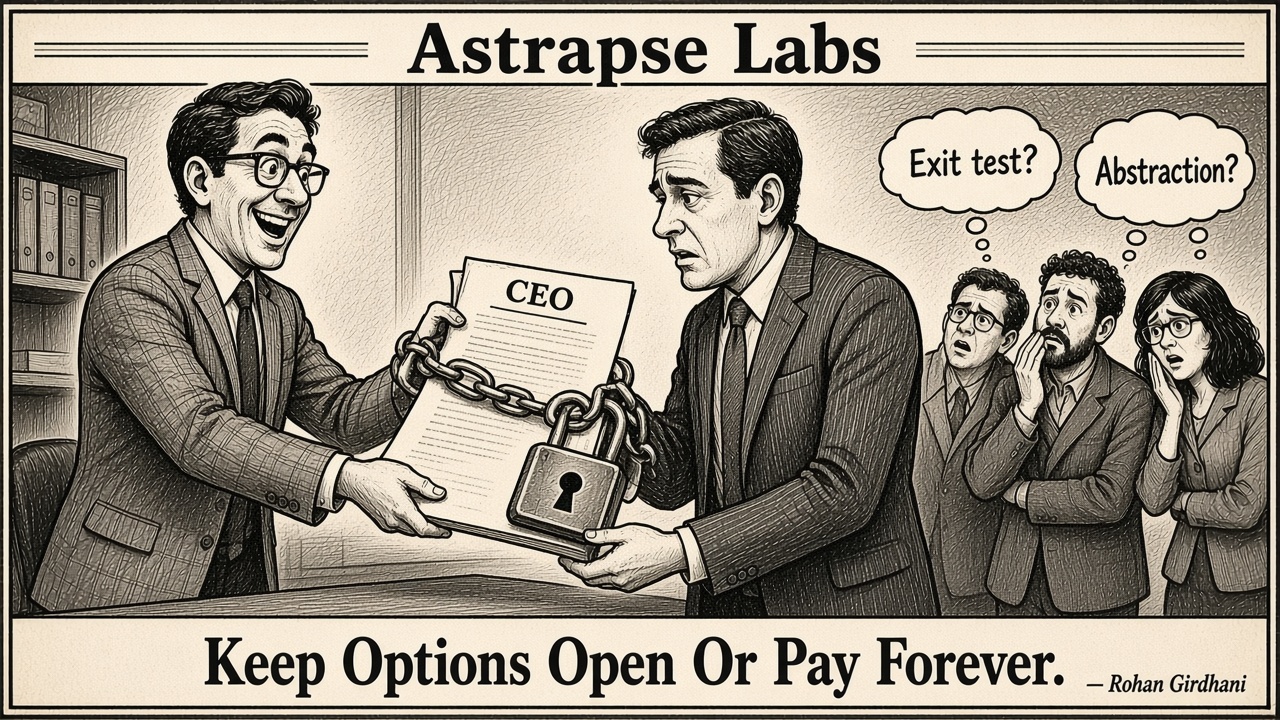
- Abstraction layers – a thin service that translates your internal request format to the vendor’s API.
- Exit tests – automated checks that verify a model swap does not degrade key metrics.
- Ownership decisions – a clear split between what you build in‑house and what you consume as a service.
We have applied these levers across more than 30 shipped startups, and they form the backbone of our advisory engagements.
Abstraction layer checklist
| Item | Why it matters | Quick Monday test |
|---|---|---|
| Unified request schema | Decouples business logic from vendor specifics | Write a JSON schema for prompts and responses; validate against existing calls |
| Adapter pattern | Allows multiple vendor adapters behind the same interface | Stub an adapter for an open‑source model and run the swap‑out script |
| Logging & metrics | Captures latency, cost, and error rates per vendor | Add a log line that tags the vendor name; compare before and after a test swap |
| Version pinning | Prevents silent upgrades that change behavior | Record the exact model version in configuration; confirm it does not auto‑update |
Implementing this checklist takes a few developer days but pays off when pricing changes or a new vendor offers a better fit.
Exit tests you can run today
- Metric parity – define a set of business‑critical metrics (e.g., classification F1, response latency). Run the same test set against the current model and a candidate alternative. Any deviation beyond a pre‑agreed threshold triggers a review.
- Prompt stability – generate a batch of representative prompts, capture outputs from both models, and compute similarity scores. Large drift indicates hidden coupling.
- Cost simulation – use the vendor’s pricing calculator to estimate cost at projected volume for each model. Compare against budget constraints.
- Compliance check – verify data residency and audit logs for the alternative provider.
These tests can be scripted in CI/CD pipelines, giving you continuous visibility into lock‑in exposure.
What to own vs. what to rent
| Layer | Own (build in‑house) | Rent (use as service) |
|---|---|---|
| Data ingestion & labeling | ✔️ | — |
| Prompt engineering framework | ✔️ | — |
| Core inference engine (model weights) | — | ✔️ (if you accept a managed LLM) |
| Model hosting & scaling | — | ✔️ (cloud provider) |
| Monitoring & alerting | ✔️ (custom dashboards) | — |
| Security & compliance tooling | ✔️ (ISO/IEC 27001 aligned) | — |
Rohan Girdhani, our founder and ISO/IEC 27001 Lead Auditor, advises that the decision hinges on risk tolerance and the strategic value of the model itself. If the model is a differentiator, owning the weights may be justified; otherwise, renting reduces operational burden.
Putting the plan into motion
- Create a lock‑in register – a living document that lists every external AI component, its contract terms, and the exit criteria.
- Build the abstraction service – start with a minimal wrapper that handles one high‑impact use case. Expand iteratively.
- Integrate exit tests into CI – add a nightly job that runs the parity suite against a secondary model.
- Review ownership quarterly – ask whether any rented layer has become a strategic asset and adjust the register.
- Engage us early – whether you need a costed recommendation, a guided implementation, or a full build‑and‑run partnership, we can align with your timeline.
Our three engagement modes—Advisory, Guided, and Advisory + Delivery—let you choose the level of involvement that matches your appetite for risk and speed.
Sources
Frequently asked
How do I know if my current vendor is already creating lock‑in?
Look for hidden dependencies: version‑auto‑updates, proprietary data formats, and lack of clear cost forecasts. The lock‑in register makes these visible.
Can I use an open‑source model as an exit test without fully switching?
Yes. Deploy the open‑source model in a sandbox, run the exit test suite, and compare results. This gives you a baseline without impacting production.
What if my compliance team rejects a vendor’s data handling policy?
Run the compliance check portion of the exit tests. If the vendor fails, the abstraction layer lets you swap to a compliant alternative without rewriting business logic.
How much does building an abstraction layer cost?
Costs vary by scope. Our Advisory engagement provides a costed, falsifiable recommendation before any work begins.
Should I own the model weights for a core product?
Only if the model itself is a competitive advantage and you have the expertise to maintain it. Otherwise, renting keeps focus on your domain expertise.