
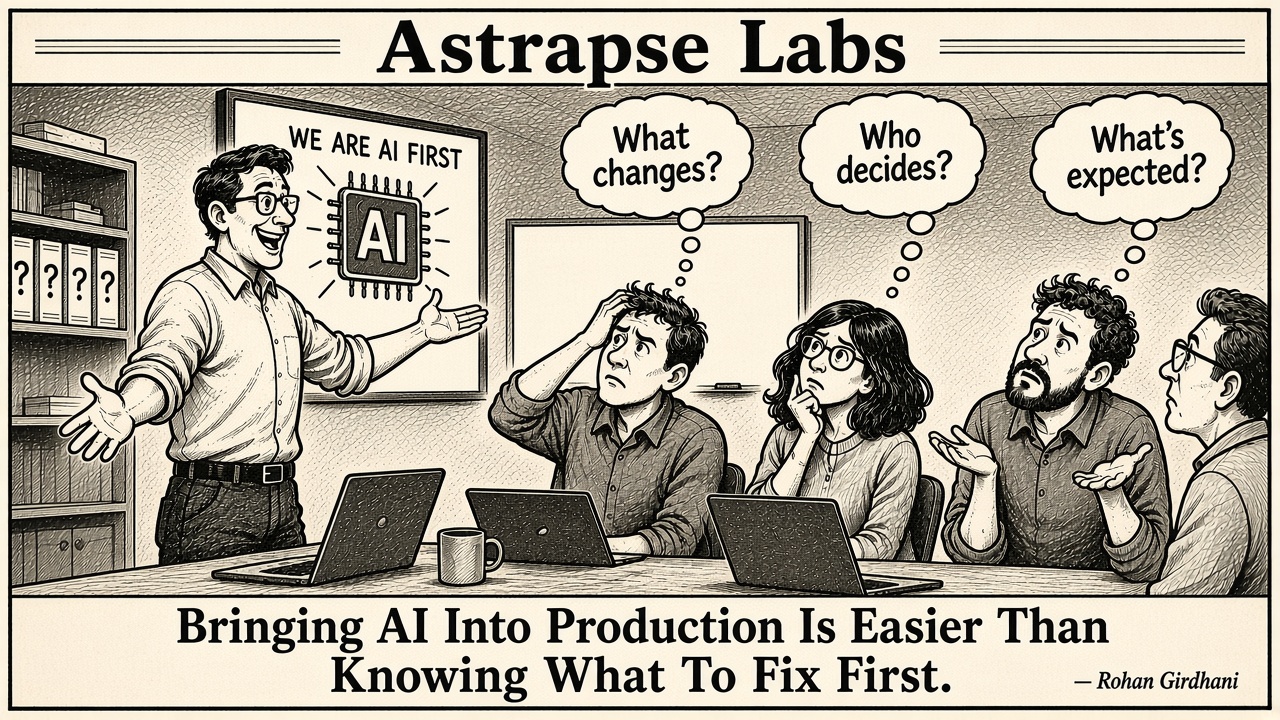
When a pilot finishes, the excitement can fade quickly. The model that performed well in a sandbox often meets resistance when it needs to run on live data, under real‑time SLAs, and with a clear owner. In the first 100 words we set the stage: the pilot‑to‑production gap is not a technology problem; it is an ownership, data, and budget problem. Below we walk through each of those three dimensions, point out the exact symptoms that signal a stall, and give you a concrete checklist to start fixing them on Monday.
The Common Break Points
A pilot typically follows a tight loop:
- Define a narrow use case – often a single department or a well‑curated dataset.
- Build a proof‑of‑concept model – data scientists iterate quickly, using notebooks and cloud notebooks.
- Validate on a test set – metrics look good, stakeholders are impressed.
- Hand off – the team expects the model to be deployed.
What we see repeatedly is that steps 3 and 4 are where the line cracks. The model’s performance on the test set does not translate to production because the underlying assumptions have shifted. The symptoms are easy to spot:
- Data drift – the live feed contains fields, formats, or volumes not seen in the pilot.
- Latency spikes – the model was tuned for batch runs, but the business now needs sub‑second responses.
- Stakeholder disengagement – the sponsor who championed the pilot is no longer the decision‑maker for the operational budget.
If you notice any of these, you are already in the stall zone.
Ownership: Who Owns the Model After the Pilot?
During the pilot, the data science team owns the model end‑to‑end. Once the pilot ends, ownership must shift to an operational team – usually engineering, platform, or a dedicated AI Ops group. The transition fails when:
- No documented hand‑off – the model’s code, environment, and monitoring setup are scattered across notebooks and ad‑hoc scripts.
- Ambiguous responsibility – the product manager assumes the engineering team will run it, while engineering expects the data science team to keep tweaking it.
- Missing governance – there is no clear policy for model versioning, rollback, or compliance checks.
What to do on Monday:
- Create a one‑page ownership matrix – list the model, its inputs, outputs, and the responsible owner for each lifecycle stage (build, test, deploy, monitor, retire).
- Schedule a joint hand‑off meeting – invite the data science lead, the engineering lead, and the business sponsor. Capture decisions on service‑level expectations and escalation paths.
- Document the deployment artefacts – store the Dockerfile, CI/CD pipeline scripts, and monitoring dashboards in a shared repository with version control.
A clear matrix eliminates the “who does what” ambiguity that stalls progress.
Data: From Sandbox to Enterprise Pipelines
Pilots thrive on curated datasets. Production demands a robust data pipeline that can handle scale, schema evolution, and security constraints. The most common data‑related roadblocks are:
- Schema mismatch – the live source adds new columns or changes data types, breaking the model’s input contract.
- Latency and freshness – the pilot used nightly batch loads; the production use case needs near‑real‑time streams.
- Governance gaps – data lineage is not tracked, making it impossible to audit model decisions for compliance (ISO/IEC 27001, for example).
Monday actions:
- Map the pilot data schema to the production source – list every field, its type, and any transformation applied. Flag any fields that are missing or have different formats.
- Prototype a data ingestion test – pull a small slice of live data through the intended pipeline and run the model in a sandbox. Verify that the model can ingest, preprocess, and produce predictions without errors.
- Add data‑lineage hooks – even a lightweight logging step that records source IDs and timestamps will satisfy the first compliance checkpoint.
By confirming that the data contract holds before full rollout, you avoid the classic “data drift after launch” trap.
Budget: From Project Spend to Ongoing Cost Model
A pilot is usually funded as a fixed‑price or time‑boxed project. Production, however, incurs recurring costs: compute, storage, monitoring, and personnel. The budget stall manifests as:
- No approved OPEX line item – finance sees the model as a one‑off expense and refuses to allocate cloud spend.
- Unclear cost attribution – the engineering team cannot predict the incremental cost of adding the model to an existing service.
- Missing ROI framework – executives cannot justify the ongoing spend without a measurable business impact.
Monday actions:
- Run a cost‑simulation – use the cloud provider’s pricing calculator with the projected request volume and model latency to estimate monthly compute cost.
- Draft a simple ROI template – list the expected benefit (e.g., reduced manual review time) and the cost estimate. Even a rough figure helps finance sign off.
- Identify a cost owner – assign the budget responsibility to the product line that will reap the benefit, not to the data science team.
When the financial gate is opened with a clear cost model, the production rollout can proceed without last‑minute funding roadblocks.
Execution Checklist for Monday
| Area | Immediate Action | Owner |
|---|---|---|
| Ownership | Create ownership matrix and schedule hand‑off meeting | CTO / Product Lead |
| Data | Map pilot schema to production, run ingestion test, add lineage logging | Data Engineering |
| Budget | Run cost simulation, draft ROI, assign cost owner | Finance Partner |
| Governance | Record model version, set up monitoring dashboard, define rollback procedure | Platform Ops |
Having this table in a shared document (e.g., Confluence or Notion) and assigning owners with due dates turns the abstract “pilot‑to‑production gap” into concrete work items.
How Astrapse Labs Can Help
We have guided more than 30 startups through the same transition, and we have built the same systems for enterprises across the US, Europe, the Middle East, India, and Singapore. Our three engagement modes let you choose the level of involvement you need:
- Advisory – we deliver a costed recommendation and step back.
- Guided – you lead, we stay alongside on major decisions.
- Advisory + Delivery – we build and run the solution end‑to‑end.
Rohan Girdhani, our founder, is an ISO/IEC 27001 Lead Auditor and coaches CTOs one‑on‑one. If you need a partner who can both advise and execute, a brief discovery call is the fastest way to align on scope.
Schedule a conversation with Rohan
For more on our approach, see our blog and the main Astrapse Labs site.
Sources
Frequently asked
What is the biggest reason pilots fail to reach production?
The most frequent cause is a lack of clear ownership after the pilot ends. When no team is explicitly responsible for deployment, monitoring, and maintenance, the project stalls.
How much data preparation is typically needed before production?
It varies, but a practical rule is to allocate at least 30 % of the pilot timeline to building a robust data pipeline that mirrors the live environment.
Can we reuse the pilot model without retraining?
Often the pilot model can be reused if the data contract holds and the latency requirements are met. However, a short validation run on live data is essential before full rollout.
How do we justify the ongoing cost to finance?
Present a simple ROI calculation that pairs the estimated monthly cost (derived from a cloud pricing simulation) with the quantifiable benefit, such as time saved or error reduction.
Should we build an in‑house AI Ops team or outsource?
Both approaches work. If you lack internal expertise, a guided or advisory + delivery engagement with a firm that has delivered 30+ AI projects can accelerate the transition.